


Make Money Skills Click
Kids learn faster when they can touch, move and compare real-looking money. Hands-on practice helps counting, paying and making change feel clear and fun.
Make counting money click with hands-on play Practice real-life paying and making change
Magnetic bills and coins make lessons easy to see Great for whiteboards, classrooms and home
67-piece set for interactive money activities Includes magnetic money, play board and activities
Build confidence with coins, bills and money values Practice identifying, counting and comparing money
Couldn't load pickup availability
A complete 67-piece magnetic money learning set:
Choose a picture card and read the price. Use magnetic bills and coins to show how you would pay.
Work out change using the board, then wipe clean and try another amount.
Perfect for small-group lessons, math centers and home practice.
Age restriction: 5 years or older
Enjoy free, fast shipping on all orders over $60 across the continental US.
Try your set for 60 days with our money-back guarantee. If you’re not happy, contact us within 60 days—we’ll make it right or arrange a full refund.

Pairs great with:


Hands-on money skills, happy learning moments—and practical support for parents and teachers.
Kids learn faster when they can touch, move and compare real-looking money. Hands-on practice helps counting, paying and making change feel clear and fun.
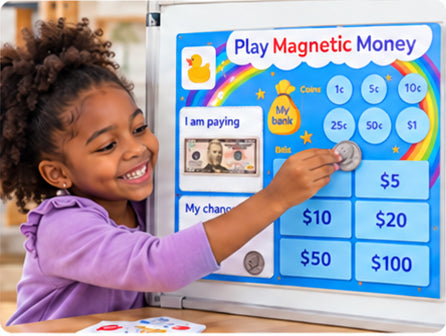
Magnetic bills and coins stay in place on whiteboards and other magnetic surfaces, making demos, small groups and home practice feel smoother and less frustrating.
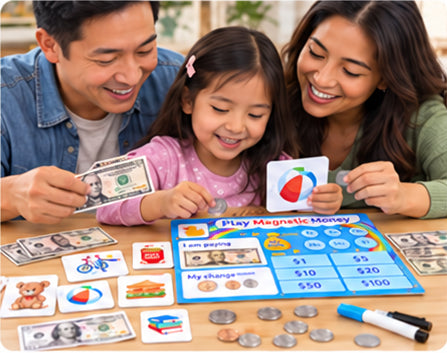
With magnetic bills, coins, picture cards, activity cards, a board and markers, the set supports counting money, identifying values, adding, subtracting and making change.

Picture prompts and guided activities make it easy to start lessons quickly and turn everyday money practice into meaningful learning time.

Triple Quality Guarantee
Made to meet recognized safety standards for classroom and home use.

Independently tested for quality, durability, and safe everyday learning.

Try it for 60 days. If you’re not happy, contact us for your money back.
Loved by 500,000+ Teachers & Families
Us vs. Them
Hands-on money practice, magnetic teaching support and easy-start activity ideas—benefits teachers and families consistently appreciate.
 Best choice for money skills practice
 Hands-on money learning
 Strong magnetic pieces
 Durable, thick materials
 Complete 67-piece set
 Helpful activity cards
 Great for class and home
 Makes learning change easier
Less prep. Less confusion. More "get it!" moments.
Research is clear: when kids can see it, touch it, and build it, they truly understand it-and remember it.
 1
Manipulatives help students visualise money values, count coins and bills, and make sense of addition and totals in a concrete way.
Math With Concrete Manipulatives – Carbonneau, Marley & Selig (2013)
 2
Hands-on practice with coins and bills helps students make connections between numbers, values and real-world situations like buying, paying and making change.
Should You Show Me the Money? – McNeil, Uttal, Jarvin & Sternberg (2009)
 3
Using physical money manipulatives across multiple senses (visual, tactile and kinesthetic) helps students remember values and concepts longer.
Math With Concrete Manipulatives – Carbonneau, Marley & Selig (2013)
 4
Manipulatives reduce cognitive load, helping students work step-by-step through money problems, make change and build independence in real-life math.
Rethinking Concrete Materials – McNeil & Uttal (2009)
 5
Visual and tactile money tools make math more accessible for diverse learners, including those who struggle with abstract concepts or need extra support.
Should You Show Me the Money? – McNeil, Uttal, Jarvin & Sternberg (2009)
Hands-on models can help learners connect concrete actions with pictures, language, and symbols.
Ideas for Hands-On Learning
Start with a simple money model and ask your child to describe what they see.
Let children move the pieces and explain the change in their own words.
Connect the hands-on model to a drawing and then to a written number sentence.
Revisit the same idea with a new example to build confidence.
Find practical answers about your magnetic money set—from teaching money skills and making change to magnets, materials and our 60-day guarantee.
Kids can practice identifying coins and bills, counting money, comparing values, adding totals and making change. The hands-on format turns real-life money skills into something visual, active and easier to understand.
Yes. The bills and coins have magnetic backing, so they stick to whiteboards, refrigerators and other magnetic surfaces. That makes demonstrations, small-group lessons and at-home practice much easier.
The 67-piece set includes 12 US bills, 30 magnetic coins, 10 activity cards, 10 magnetic picture cards plus 2 blank ones, 1 magnetic board and 2 dry erase markers.
Yes. Families and teachers often mention that the pieces feel sturdy and classroom-ready. The bills are thick, the magnets are strong, and the set is designed for repeated practice at home or school.
They’re designed to look realistic enough for learning and pretend play while still being easy for kids to handle. Some families note that the coin sizes are not exactly true to life, but they still work well for teaching value recognition and money practice.
Yes. It works well for teacher demonstrations, math centers, tutoring, homeschool and one-on-one practice. The magnetic format helps keep lessons organized and easy to see.
Absolutely. Many families use it for paying, counting and making change. The activity cards and board make it easier to build real-life practice into play and math lessons.
Try your set for 60 days with our money-back guarantee. If you’re not happy, contact us within 60 days—we’ll make it right or arrange a full refund.

Watch families put Base Ten activities, a Kids Calendar, and Educational Posters to use.
 Build place value with Base Ten blocks
 Make calendar time a daily learning moment
 Keep 50 learning designs within reach
 Learn a Second Language with English-Spanish Flash Cards!


